The Voyager mission, since 1977

The most distant thing humans have ever made

Two spacecraft the size of a small car have been flying for half a century. They visited four giant planets, left the Sun's bubble and still send data home on a signal weaker than a billionth of a billionth of a watt.

Voyager 1

Distance from Earth
25,912,555,431 km
Distance from the Sun
172.438 AU
Signal travel time to Earth
24 h 00 min 34 s
Speed relative to the Sun
16.918 km/s
One light-day100.040 %

Voyager 2

Distance from Earth
21,698,973,879 km
Distance from the Sun
144.550 AU
Signal travel time to Earth
20 h 06 min 19 s
Speed relative to the Sun
15.263 km/s

Computed live from NASA JPL Horizons ephemerides, updated November 23, 2026.

Voyager 1 is now more than one light-day from Earth. Its radio signal takes over 24 hours to arrive. It crossed that line in November 2026.

Start the journey
The journey

Scroll and time moves with you. The trajectories are real, computed from JPL ephemerides. Distances from the Sun are shown on a logarithmic scale, otherwise the inner planets would collapse into a single point.

  1. August to September 1977

    Launch

    Voyager 2 launched on 20 August 1977, Voyager 1 sixteen days later. Both rode a Titan IIIE/Centaur rocket from Cape Canaveral. The outer planets had lined up in a way that happens roughly once every 175 years, so each one could fling the spacecraft on to the next.

  2. March and July 1979

    Jupiter

    Voyager 1 flew past Jupiter on 5 March, Voyager 2 on 9 July. They found the first active volcanoes beyond Earth on the moon Io, a thin ring around Jupiter and new small moons. The Great Red Spot turned out to be a giant storm spinning counterclockwise.

  3. November 1980 and August 1981

    Saturn and Titan

    On 12 November 1980 Voyager 1 swung close to Titan, a moon with a thick nitrogen atmosphere. The manoeuvre threw it out of the plane of the planets and ended its planetary tour. Voyager 2 passed Saturn in August 1981, and the planet's gravity sent it on towards Uranus.

  4. 24 January 1986

    Uranus

    Voyager 2 is still the only spacecraft to have visited Uranus. It discovered ten new moons and two rings, and found the planet's magnetic field tilted about 59 degrees from its rotation axis. The moon Miranda looks as if it was assembled from mismatched pieces.

  5. 25 August 1989

    Neptune and Triton

    At Neptune, Voyager 2 found the Great Dark Spot and the fastest winds in the Solar System, around 2,000 km/h. On icy Triton it caught nitrogen geysers. It passed only about 5,000 km above Neptune's north pole cloud tops, its closest pass of any planet.

  6. 14 February 1990

    The Pale Blue Dot

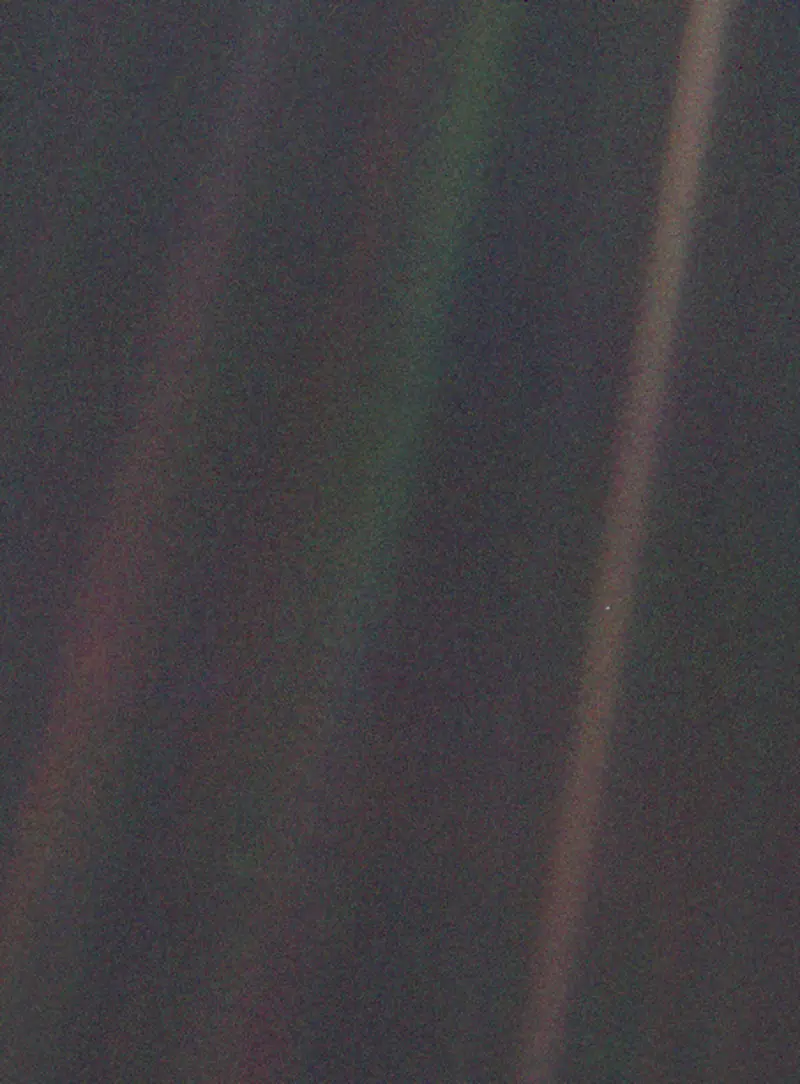
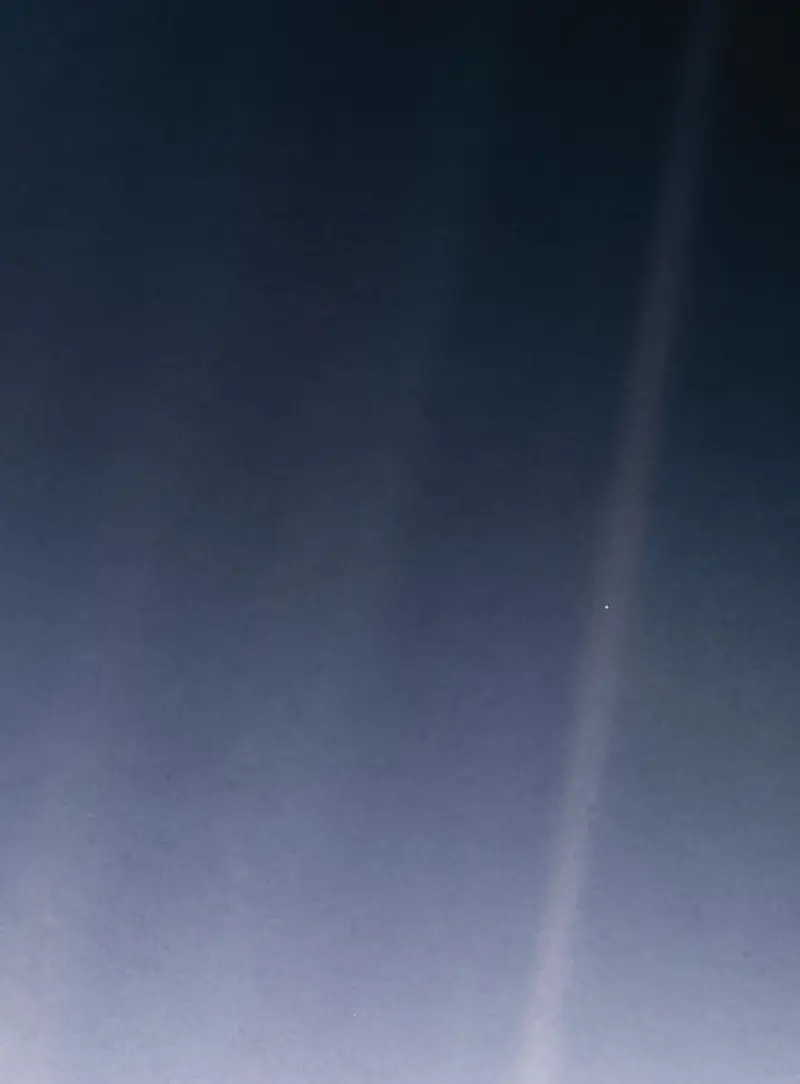
    At Carl Sagan's urging, Voyager 1 turned around and photographed six planets from about six billion kilometres away. Earth takes up less than a single pixel. Shortly afterwards the cameras were switched off to save power and memory for the long road ahead.

  7. 2004 and 2007

    The termination shock

    The solar wind travels at supersonic speed, but far from the Sun it suddenly slows down. Voyager 1 crossed this shock in December 2004 at about 94 AU, Voyager 2 in August 2007 at about 84 AU. Beyond it lies the heliosheath, the turbulent outer layer of the Sun's bubble.

  8. 25 August 2012 and 5 November 2018

    Interstellar space

    Voyager 1 crossed the heliopause, the boundary between solar and interstellar plasma, on 25 August 2012 at 121 AU. Particles from the Sun dropped sharply and cosmic rays from the Galaxy rose. Voyager 2 crossed in November 2018 at 119 AU and, with its plasma instrument still working, measured the boundary directly.

  9. Today

    Today

    Voyager 1 has been the most distant human-made object since February 1998, when it overtook Pioneer 10. Power drops by about 4 watts a year, so the team switches instruments off one by one. In 2023 and 2024 engineers worked around a failed memory chip from billions of kilometres away and saved the spacecraft. Both probes might keep talking to Earth into the early 2030s.

The spacecraft

Each Voyager weighs over 800 kg. Its power comes from three radioisotope generators fuelled by plutonium 238, because solar panels would not work that far from the Sun. The main antenna is 3.7 metres across and the transmitter puts out about 23 watts, roughly a fridge light bulb.

Instrument status

 V1V2
HGAHigh-gain antennaA 3.7 m dish transmitting at 8.4 GHz. It has to point precisely at Earth.
RTGRadioisotope thermoelectric generatorsHeat from decaying plutonium 238 is turned into electricity. About 470 W at launch.
MAGMagnetometerMounted on a 13 m boom, far from the spacecraft's own interference, it measures magnetic fields.OnOn
PWSPlasma wave subsystemListens to plasma oscillations. It is how we know Voyager 1 is in interstellar space.OnOn
CRSCosmic ray subsystemCounts high-energy particles from the Galaxy and the Sun.OffOn
LECPLow-energy charged particle instrumentMeasures lower-energy ions and electrons, typical of the solar wind.OnOff
PLSPlasma science instrumentMeasures speed, density and temperature of plasma. Failed on Voyager 1 in 1980.OffOff
ISSCamerasWide-angle and narrow-angle cameras. Off since 1990, after the Pale Blue Dot.OffOff

Status per NASA JPL as of 2025. For 2026 the team plans to switch off LECP on Voyager 1 and CRS on Voyager 2.

How to tell you have left the Sun

In August 2012 the detectors on Voyager 1 saw particles from the heliosphere fall a hundredfold within days while cosmic rays from the Galaxy rose. The chart shows the real daily measurements.

Loading data...

On 25 August 2012 low-energy protons from the heliosphere dropped roughly a hundredfold and cosmic rays from the Galaxy rose by about a fifth. The vertical axis is logarithmic.
Open the data lab

A voice from far away

Voyager transmits at about 23 W. By the time the signal reaches Earth its power has fallen to a fraction of an attowatt. Only the giant dishes of the Deep Space Network in California, Spain and Australia can hear it. Voyager 1 now sends science data at 160 bits per second.

The animation shows the signal sped up. In reality it takes over a day.

Who is talking to Voyager right now

Loading live DSN data...

Source: NASA DSN Now, refreshed every minute.

Running out of power

Plutonium 238 has a half-life of 87.7 years, but the thermocouples age faster. Power drops by about 4 W a year, so the team turns off heaters and instruments one by one to keep the spacecraft alive as long as possible.

  • 1980 PLS fails
  • 1990 Cameras off
  • 2007 PRA off
  • 2016 UVS off
  • 2025 CRS off
Approximate model of Voyager 1 power output and instrument shutdowns.0100200300400500198019902000201020202030Power (W)PLS failsCameras offPRA offUVS offCRS off
Approximate model: 470 W at launch, minus 4 W a year. Real values differ slightly.
Golden Record cover

The Golden Record

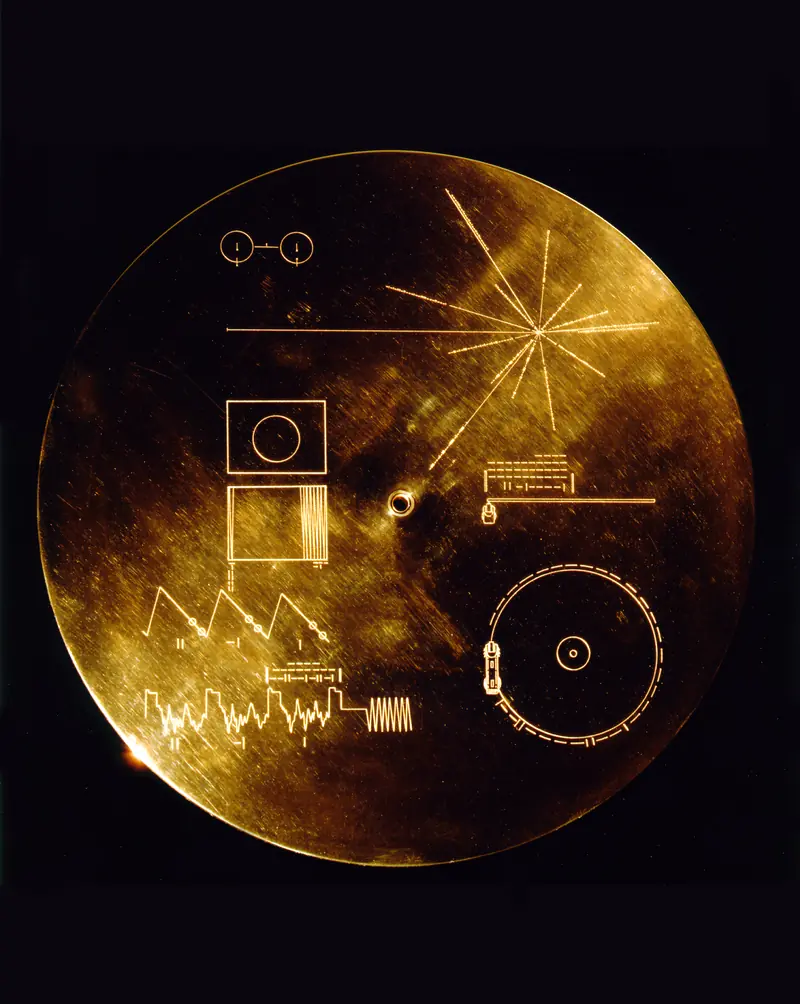
Both spacecraft carry a gold-plated copper record for anyone who might find them. A committee led by Carl Sagan chose the contents: 115 images, greetings in 55 languages, sounds of Earth and 90 minutes of music from Bach to Chuck Berry.

1 How to play it

The drawing of the record and its stylus shows where to put the needle and how fast to spin it. Time is written in binary, in units derived from the hydrogen atom.

What is on the record

115
images encoded as analogue signal
55
languages of greetings
27
pieces of music
90
minutes of music

Much of the music on the record is still under copyright, so we do not play it here.